CLOSE
Relax, we can help.
With so many features and functions, we fully understand that getting the software to do what you want can be daunting at times.
YIKES! ✕
CHANGES SAVED
SESSION EXPIRED
We appreciate that your browser hung out with us for so long, but your session has expired! If you want to register, we need to refresh your connection. We limit session time to 30 minutes for your security and to free up unused registration slots for others.
SESSION EXPIRED
Your session on this page has expired. We expire your session to protect your information in case you sit on a page too long with no activity.

Masculinity, Trauma Responses, and High-Risk Behavior in Men

Please sign in to access your itinerary, materials and links to all your sessions.

Please enter your access code!
CONTACT HOST
✕
Primary Contact:
WDVA VTSC Program
SHARE
✕
Overview
Veteran Counseling P
Virtual Event Link
Audience
Confidentiality
Conflict of Interest
CE Credits
Attendance/No Show
Documents
Register ▸
Masculinity, Trauma Responses, and High-Risk Behavior in Men
Mon, December 07, 2026
Event Banner
✖
THIS EVENT IS 100% FREE!

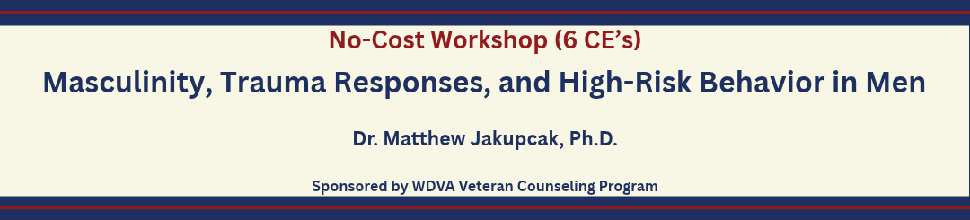
Masculinity, Trauma Responses, and High-Risk Behavior in Men


Time: 9:00am-4:00pm

Location: Virtual

Instructor: Dr. Matthew Jakupcak, Ph.D

CE credits: 6.0 (pending)


Course Description:

In this training, attendees will learn the impact of traditional, hegemonic masculinities on men's experience and expressions of trauma reactions, often by enacting high-risk behaviors. You will also learn how culturally informed masculinities impact help-seeking behaviors, and in particular how male gender norms inform men's use of behavioral health services. Finally, attendees will learn how to adapt and apply evidence-based strategies to address emotional regulation and high-risk behaviors using culturally responsive approaches.


Learning objectives. 

At the end of this training participants will be able to:

  • Explain the impact of traditional, hegemonic masculinities on men's experience and expressions of trauma response, often by enacting high-risk behaviors.
  • Summarize how masculinities impact help-seeking behaviors, and in particular how male gender norms inform men's use of behavioral health services.
  • Adapt and apply evidence-based strategies to address emotional regulation and high-risk behaviors using culturally responsive approaches.


References:

Mostoller, A. M., & Mickelson, K. D. (2024). Masculinity and Mental Well-Being: The Role of Stigma Attached to Help-Seeking Among Men. Sex Roles, 90, 353–362. https://doi.org/10.1007/s11199-024-01457-2


Wong, Y. J., Ho, M.-H. R., Wang, S.-Y., & Miller, I. S. (2017). Meta-analyses of the relationship between conformity to masculine norms and mental health-related outcomes. Journal of Counseling Psychology, 64(1), 80–93. https://doi.org/10.1037/cou0000176


Zamboanga, B. L., Newins, A. R., Ford, K., & Perrotte, J. K. (2024). Conformity to masculine norms and its association with drinking behaviors and alcohol-related consequences among adult men: A meta-analysis. Social Science & Medicine, 359, 117198. https://doi.org/10.1016/j.socscimed.2024.117198

Registration: Open
Event Date
Registration Closes
December 07, 2026 @ 6:00 pm
Location
Featured Speakers
INSTRUCTOR
Photo of Matthew Jakupcak, PhD
Matthew Jakupcak, PhD
Clinical Psychologist, Matthew Jakupcak, Ph.D.
Selection Options
Virtual Event
Virtual Event
 
Monday Dec 07, 2026 @  09:00:AM  —  04:00:PM PST

Virtual link will be emailed to participants the day before the event.

 
Attendee Registration
›
POWERED BY